The Origin of Wood Veneer
Wood veneer is a thin slice of real wood bonded onto a stable substrate. While it is sometimes mistakenly viewed as a “cheaper alternative” to solid wood, veneer is actually one of the oldest and most refined woodworking techniques in history.
Archaeological evidence suggests that ancient Egyptian artisans were among the first to use what we would recognize today as veneer. Wood was a precious resource in the Nile region: native species like acacia and sycamore fig were available, but prized woods such as cedar, ebony, and olive had to be imported from Lebanon, Nubia, and further south.
Because these exotic timbers were extremely costly, craftsmen used them sparingly. They cut thin sheets of these expensive woods and applied them over local softwoods to decorate furniture, sarcophagi, and ritual objects. These sheets were thicker than modern veneer but served the same purpose: maximizing the visual impact of rare species.
For following centuries, veneer was employed by Greek and Roman craftsmen to enhance furniture and architectural elements, allowing them to decorate surfaces with rare and exotic woods while economizing on materials.
During the Renaissance (14th–17th centuries), veneer evolved from a purely practical solution into a prestigious craft through the creation of intricate geometric and pictorial patterns. Italian workshops, particularly in Florence and Venice, excelled at marquetry, combining veneer with ivory, bone, and metal to create elaborate designs. Veneer became a defining feature of luxury furniture, symbolizing skill, refinement, and artistic excellence.
In the 17th and 18th centuries, veneer reached a technical and artistic peak. With the introduction of Innovations of saw-cut veneers that were thinner and more uniform, the intentional use of book matching and slip matching to create striking visual patterns and the ability to produce larger panels with consistent grain, expanding both design possibilities and decorative complexity.
All this journey leads to our modern days where veneer is largely diffused and produced with remarkable precision. In the next chapters we will see why nowadays quality veneer is valued not only for its appearance and performance but also for its sustainability, material efficiency, and creative flexibility.
Wood Veneer vs Solid Wood
Since one of the most common questions concerns how veneer compares to solid wood, it is worth highlighting the situations where wood veneer is a valuable alternative.
Veneer offers significant eco-efficiency, allowing a single log to cover many times the surface area of solid timber. It provides excellent dimensional stability, reducing expansion and contraction caused by changes in humidity. Using veneer also improves cost efficiency, making exotic wood species more accessible.
From a design perspective, it allows greater freedom, enabling large panels, book-matching, and custom patterns that would be difficult or wasteful with solid wood. Additionally, veneer creates lightweight assemblies, making it ideal for applications such as doors, cabinets, and wall paneling.
Solid wood remains the preferred choice in applications where durability under heavy use, or the ability to be sanded and refinished multiple times are critical for components often benefit from the robustness and longevity of solid timber, which can also develop a patina over time that veneers cannot replicate.
Processing from Raw Log to Finished Panels
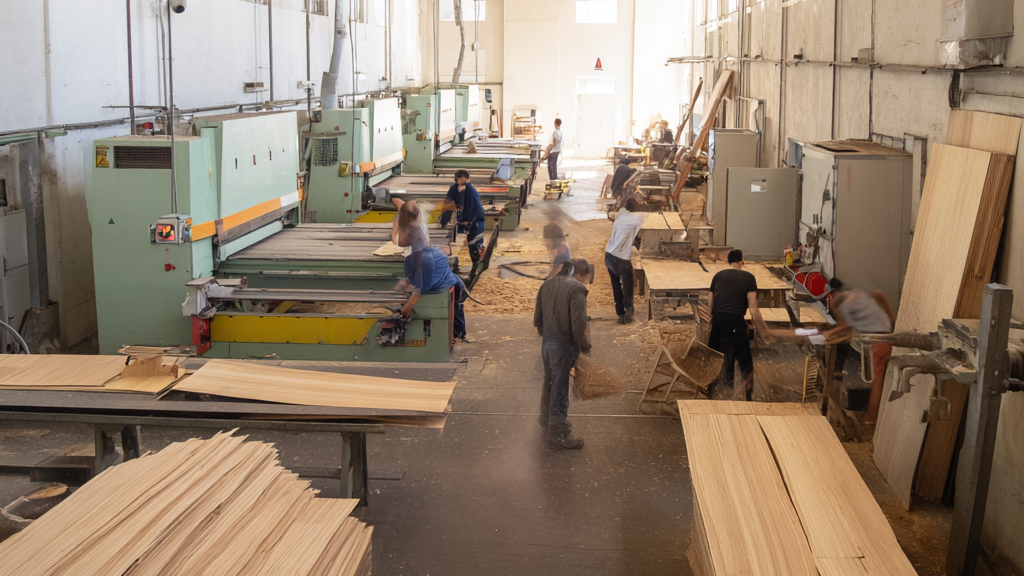
The production of veneer begins with selecting and debarking the log, which is then conditioned often through steaming or soaking to soften the fibres and ensure clean, controlled cuts. Once prepared, the log is mounted on the slicing or peeling machine, where it is cut into thin sheets according to the desired method that we’re going to deep dive in the next paragraph.
These sheets are then dried, trimmed, and graded before being assembled into bundles. In the final phase, the veneer is bonded to a substrate panel, typically MDF, plywood, particleboard, or, in more advanced applications, aluminum honeycomb using industrial adhesives and pressing systems that ensure a stable, smooth, and long-lasting surface.
Wood Species Commonly Used
One of the key advantages of wood veneer mentioned is the significant reduction in raw material consumption compared to solid timber. By slicing logs into thin sheets, manufacturers can cover large surface areas using only a fraction of the wood that would be required for solid boards.
This makes veneer an optimal solution for expensive, high-value, or slow-growing species, where responsible use of resources is essential. For this reason, species such as oak, maple, birch, cherry, walnut, and mahogany are widely used in veneer production. These woods offer stable fibre structures that perform well during slicing, drying, and pressing, and they are also available in thermo-treated versions, which enhance dimensional stability and expand their design applications.
The efficiency of veneer becomes even more critical when dealing with exotic hardwoods. Species like ebony, zebrawood, wenge, and rosewood are slow-growing, geographically limited, and often subject to strict environmental regulations. Processing them as veneer allows manufacturers and designers to access their distinctive appearance and performance characteristics while minimizing the consumption of scarce and ecologically vulnerable resources. Veneer production maximizes yield, reduces waste, and supports more responsible material sourcing, an increasingly important factor in contemporary architecture.
A more environmentally conscious alternative is the use of reconstituted (or engineered) veneers. This modern technology is produced from fast-growing, sustainably sourced woods that are dyed, laminated, and re-sliced to replicate the appearance of exotic species or to create highly consistent, repeatable patterns. Reconstituted veneers provide aesthetic versatility while further reducing reliance on rare or endangered timbers, making them a practical choice for projects with strong sustainability targets.
Types of Cuts
The way a log is cut has a direct impact on the final aesthetic of the veneer. The choice of cut influences the character of the veneer just as much as the wood species itself. It is a fundamental design decision that shapes the mood, rhythm, and identity of the final surface. Here we’re going to explore more widely used kind of cut for a log.
Rotary sawn veneer
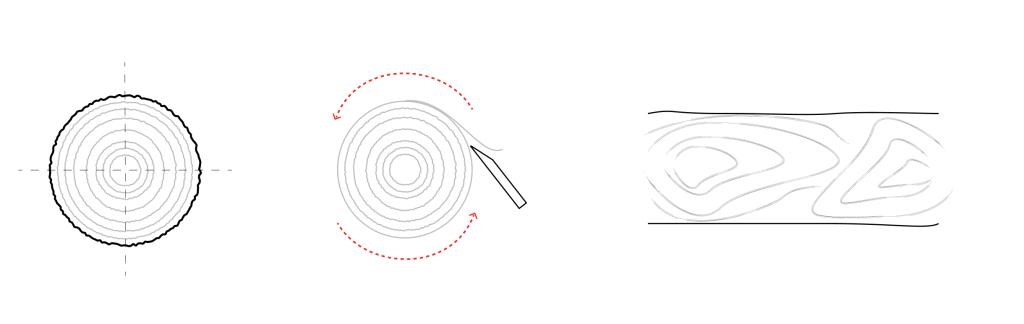
It is obtained by peeling the log in a continuous sheet, almost like unrolling a ribbon of wood. This method produces wide, bold, and often irregular patterns, and because it is the most economical technique, it is commonly used for plywood and certain architectural applications.
Flat or crown sawn
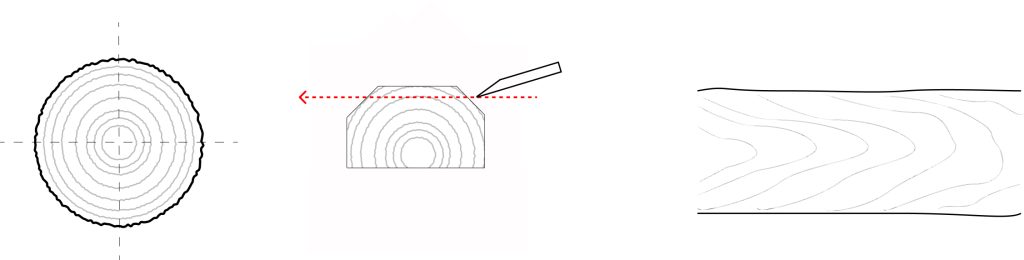
It is created by slicing the log tangent to its growth rings. This cut reveals the “cathedral” grain figure, a pattern widely appreciated in furniture production for its warm, traditional appearance.
Quarter sawn
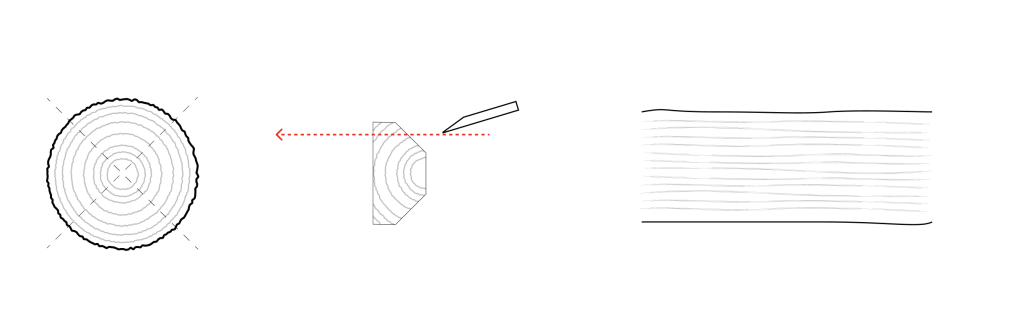
It is produced by cutting the log perpendicular to the growth rings. This results in a straight, linear grain that offers both excellent stability and a more refined, architectural look. These stripes can be straight in some woods and varies in others.
The rift cut is a variation of quarter-sawing, designed to achieve an even more uniform and vertical grain. It produces extremely straight, fine lines with minimal figure, making it especially popular for species like white oak in modern and minimal interiors where visual consistency is essential.
Half-round slicing
This is another variation of quarter-sawing, where the log is mounted off-centre and rotated against the knife. This approach combines aspects of rotary peeling and flat slicing, resulting in a surface that retains some of the sweeping, dramatic movement of rotary-cut veneer but with greater control and more consistent figure. Half-round slicing is often chosen when the goal is to highlight distinctive grain structures, such as those found in crotch, burl, or highly figured woods, while avoiding the extreme irregularity typical of full rotary cuts.
Methods of Matching and Layout
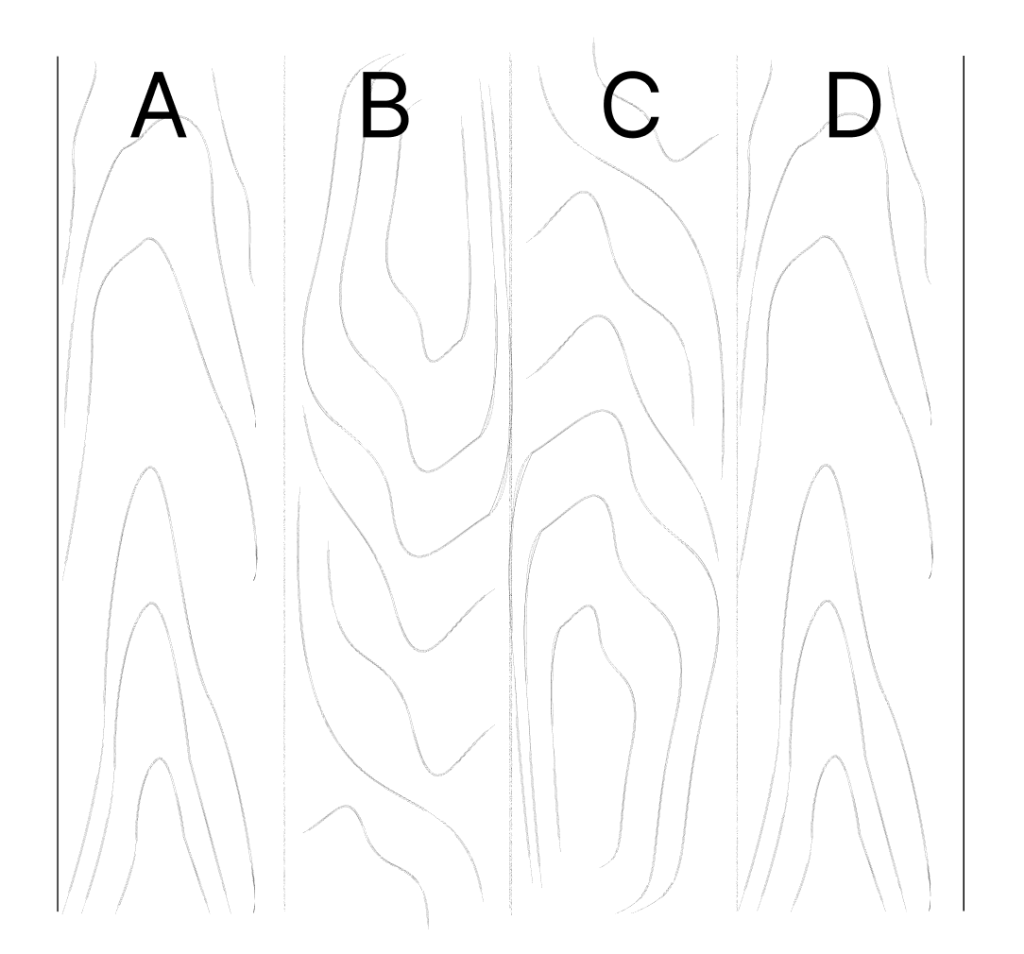
One of the biggest advantage of working with wood veneer its flexibility. How the sheets are arranged and matched can dramatically influence the overall aesthetic of a project. Matching not only affects visual rhythm and continuity, but also helps emphasize the natural beauty of the wood grain, making it a critical consideration in architectural and furniture design.
Book Matching
Consecutive veneer sheets are opened like the pages of a book so that their adjacent edges mirror each other. This creates a symmetrical, reflective pattern that highlights the grain and can produce a striking, continuous visual flow. Book matching is particularly effective for feature walls and large panels, where symmetry and pattern repetition are desirable.
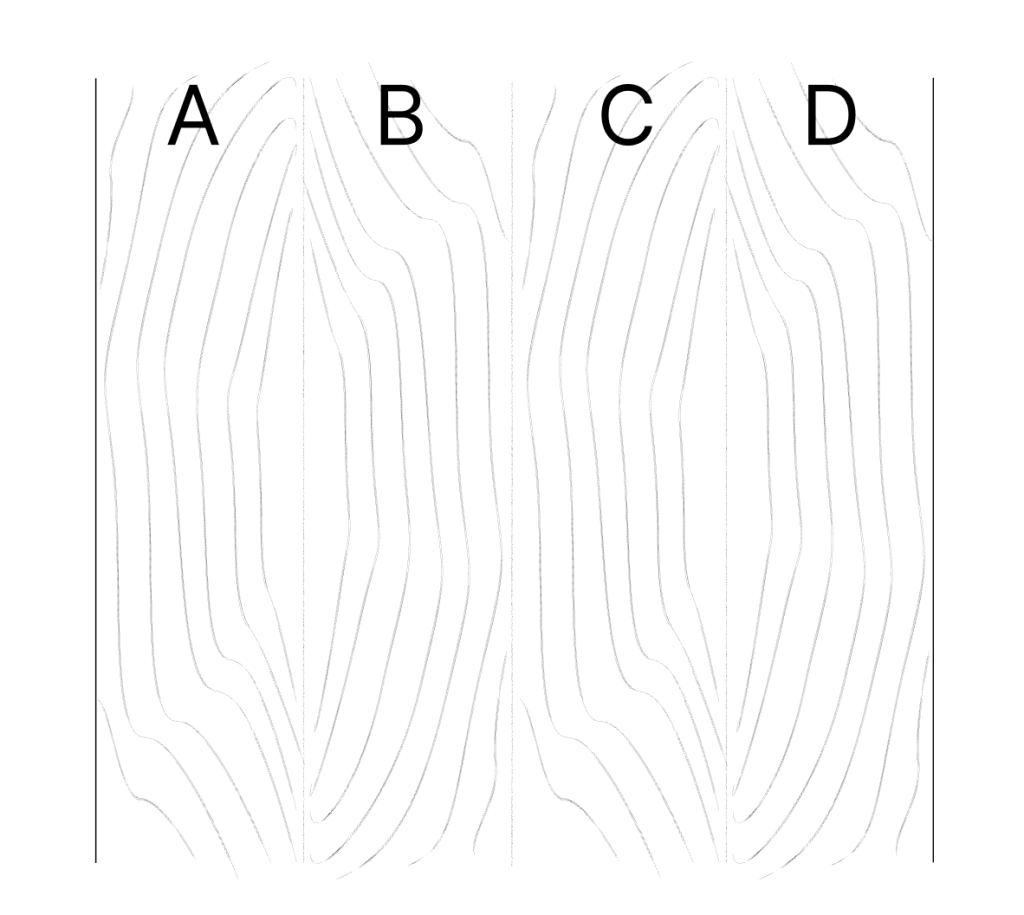
Slip Matching
It involves aligning consecutive sheets in the same grain direction without flipping them. The grain runs continuously across the panel, but the mirrored effect of book matching is avoided. This method creates a more linear and subtle continuity, suitable for modern interiors or applications where the goal is grain consistency without pronounced symmetry.
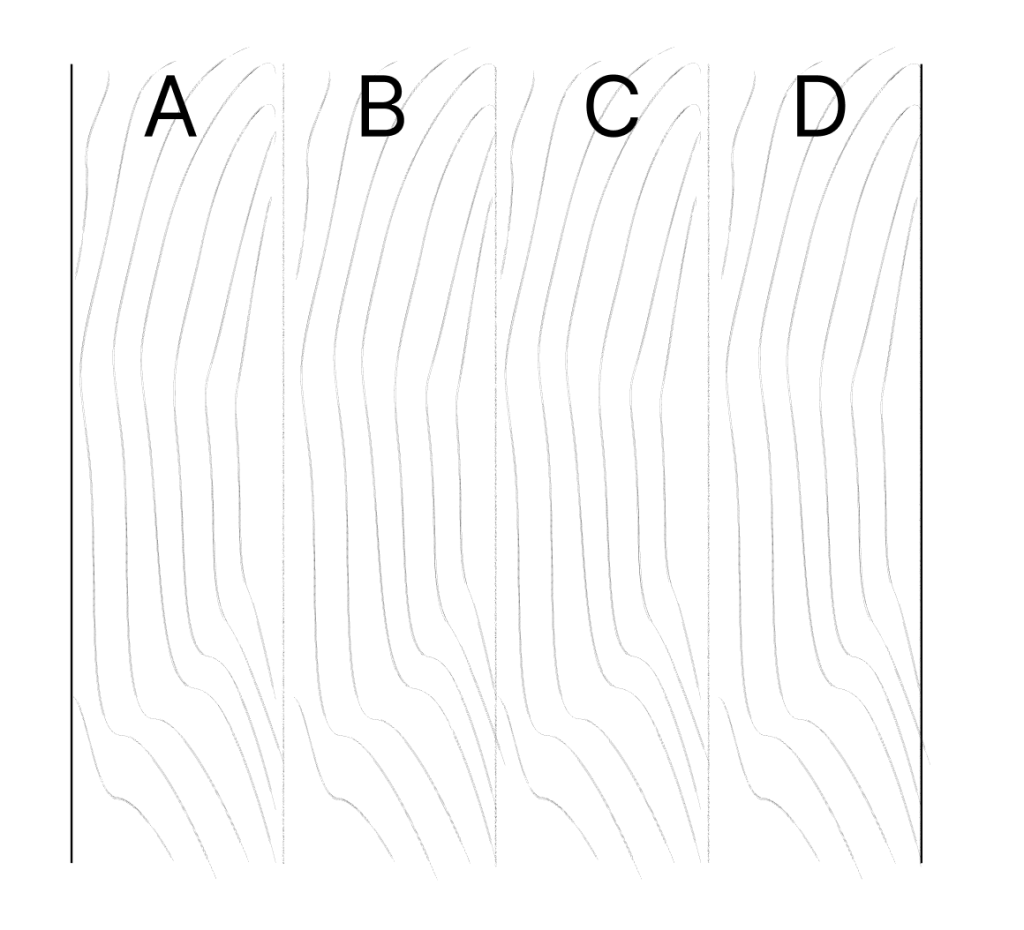
Random Match / Plank Match
Veneer sheets are arranged without a strict pattern. This method emphasizes the natural variation of the wood and is often used to create a dynamic, organic appearance, particularly in contemporary or rustic design. Random matching is ideal for applications where uniqueness and a natural look are prioritized over strict symmetry.
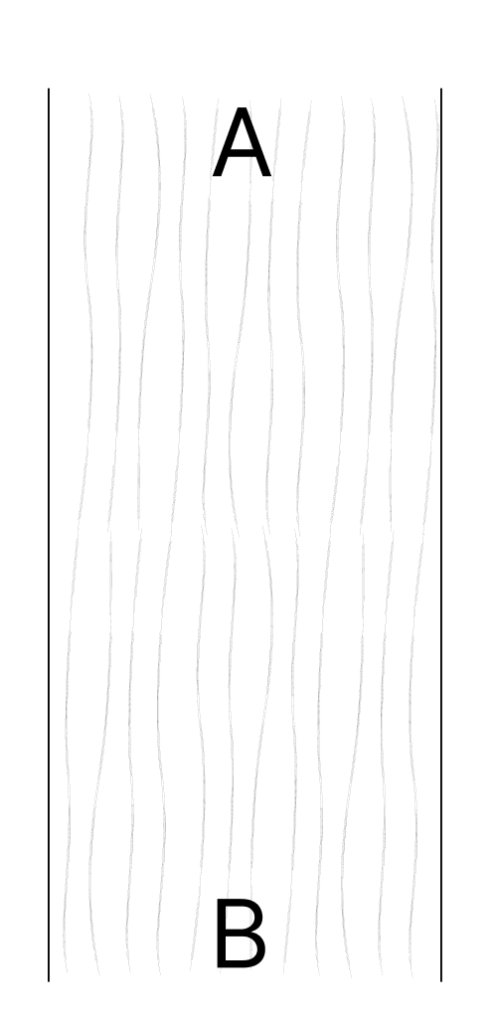
End Matching
It’s used when panels are tall or require vertical continuity, such as in doors, wall panels, or tall cabinetry. Veneer sheets are joined at the ends so that the grain continues across the height of the panel, maintaining visual flow and rhythm over longer surfaces.
The choice of matching method has a direct impact on how the eye perceives the space. Symmetrical patterns can convey formality and elegance, while slip or random matching can create a more relaxed, natural, or contemporary aesthetic. Designers often combine methods to balance continuity, visual interest, and the unique character of the wood species being used.
Characteristics and Common Applications
Designers can optimize both visual quality and long-term performance by carefully selecting the veneer thickness, balancing strategy, and substrate, eventually achieving the desired aesthetic while ensuring structural reliability across a wide range of applications.
Thickness
Wood veneer is produced in a range of thicknesses, allowing designers and manufacturers to select the optimal sheet for functional requirements. Typical thicknesses range from 0.5 mm to 2 mm (≈ 1/64″ to 3/32″), but regional conventions may differ.
Thicker veneers, generally 1.5–2 mm (≈ 1/16″ to 3/32″), are often used in high-wear areas or for edge banding, where additional material is required for durability or mechanical processing. Veneers in the mid-range thickness of 0.7–1.2 mm (≈ 1/32″ to 3/64″) are the most commonly used and are well suited for standard applications such as cabinetry, doors, and architectural panels. In contrast, ultra-thin veneers in the 0.2–0.4 mm range (≈ 1/128″ to 1/64″) are ideal for curved surfaces or complex radius work, allowing the wood to bend without cracking or splitting.
Size
The size of veneer sheets is another important factor in planning layouts and minimizing seams. Standard sheets typically measure around 250–300 cm (8–10 feet) in length and 10–120 cm (5–48 inches) in width, though these dimensions can vary depending on the species and processing method. Rotary-cut veneers, which are peeled from logs, often yield wider sheets, while sliced veneers may be narrower but have a more uniform grain appearance. Larger sheets reduce the number of joints and are preferred for continuous panels or large architectural surfaces, whereas smaller sheets are easier to handle for cabinetry, furniture, or intricate designs.
Balancing
A final crucial consideration when working with veneers is balancing. Since a single veneer layer can warp as it dries or responds to environmental changes, it is standard practice to use a backer veneer on the reverse side of the panel. This balancing layer stabilizes the board and prevents deformation, ensuring a flat, uniform surface over time.
Substrates
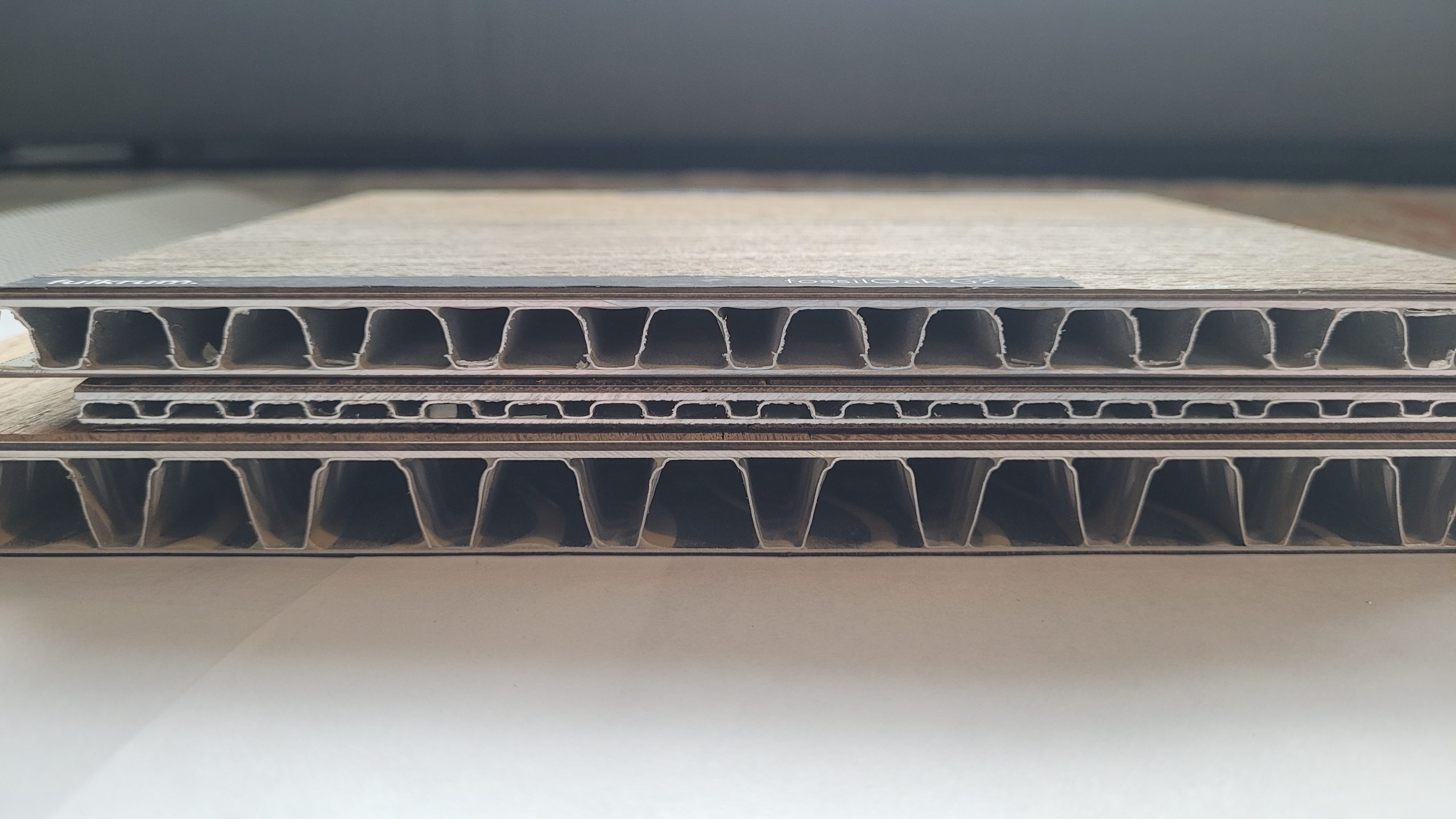
Veneers are typically bonded to substrates, which influence both performance and cost. Common options include:
- MDF (Medium-Density Fibreboard): offers a smooth, consistent surface ideal for finishing; relatively stable and cost-effective, though less resistant to moisture.
- Plywood: Stronger and more dimensionally stable than MDF; suitable for structural applications.
- Particleboard: Very economical and widely used for flat-panel furniture; less strong and more susceptible to moisture damage.
- Aluminum Panels: increasingly used in architectural interiors; lightweight, highly stable, and resistant to warping, but requiring specialized adhesives and handling.
Finishes and Treatments
The finishing of wood veneer is a critical step that enhances its appearance, protects the surface, and ensures long-term durability. Unlike solid wood, veneers are very thin, so special care must be taken during sanding, staining, or coating to avoid damaging the surface. Veneers can be treated with a variety of finishes depending on the desired look and functional requirements.
Stains and Varnish
Stains are used to enhance or modify the colour of wood while preserving its natural grain and texture. They work by penetrating the wood fibres, where pigments or dyes absorb into the porous structure, allowing the colour to integrate with the material rather than simply sitting on the surface. Light, water-based stains are often preferred because they penetrate evenly and preserve the wood’s ability to bond with subsequent coatings. Strong chemical stains can penetrate too deeply, potentially causing uneven colouration or affecting adhesion. After staining, a topcoat is typically applied to protect the wood, prolong its durability, and adjust the surface finish, providing options from matte to high-gloss effects.
Oils and Wax
Natural oils penetrate the veneer and bring out depth in the grain, creating a rich, tactile surface. Wax can be applied over oils to add a soft luster and additional surface protection. This combination is gentle on thin veneers and ideal for decorative panels or furniture surfaces not subject to heavy wear, though periodic reapplication is needed for maintenance.
Lacquers
Lacquers provide hard, durable surfaces that resist scratches, moisture, and UV degradation. These finishes are often applied in multiple thin layers, particularly in commercial or high-traffic environments. This differs from coatings on materials like MDF, where an opaque base layer conceals the natural grain. Depending on the combination of lacquer type and wood species, the finish can penetrate and partially or fully saturate the natural pores, helping to prevent water from seeping in, while the texture and grain may be more or less visible.
UV Treatment
It help preserve the material’s original colour and appearance in brightly lit spaces, where sunlight can cause yellowing, fading, or uneven tones over time. UV filters can already be integrated into oils, varnishes, or clear protective coatings; they block ultraviolet rays and stabilize the surface, keeping the wood’s colour consistent and extending its aesthetic lifespan.
Thermo-Treatment
Heat treatment modifies the wood’s cellular structure, enhancing dimensional stability, darkening the colour naturally, and improving resistance to moisture and decay. Thermo-treated veneers are especially useful for high-humidity environments or exterior applications. Care must be taken to combine thermo-treatment with compatible finishes, as the wood can be more brittle after treatment.
Wood bleaching
This technique is used to lighten the colour of wood and achieve a more uniform or brightened appearance. It is often applied when restoring furniture, brightening interiors, or preparing wood for light finishes.
Wood stripping
It is a decorative technique that creates an aged effect by emphasizing the wood grain, often applying light finishes over a darker base. Traditional methods involve chemical paint removers, while modern approaches use brushing and specialized finishes to achieve a worn, lived-in appearance.
Just to mention more traditional wood treatments such as shellac, mineral oil, and boiled linseed oil are also used to enhance and protect the wood.
Pros, Cons and Common Misconceptions
Wood veneer is often misunderstood, yet it offers a combination of aesthetic beauty, sustainability, and functional performance that makes it a preferred choice for many architectural and furniture applications. Understanding its advantages, limitations, and common misconceptions is essential for designers, fabricators, and clients alike.
Advantages
- Sustainable and resource-efficient: Veneer allows the use of small amounts of high-value or exotic woods to cover large surfaces, reducing waste and conserving limited species.
- Cost-effective access to exotic species: Designers can achieve the look of rare woods such as ebony or zebrawood without the high cost of solid timber.
- High dimensional stability: Thin veneer sheets, especially when bonded to stable substrates, are less prone to warping, cupping, or cracking than solid wood.
- Consistent appearance across large surfaces: Careful matching and layout techniques ensure uniform grain patterns across panels, which is difficult to achieve with solid timber. This allows full control over natural flaws or defects in the wood.
- Lighter than solid wood: Veneered panels depending on the structural support used might reduce weight, making them ideal for large architectural elements, cabinetry, and wall panels.
Disadvantages
- Limited reparability: Very thin veneers cannot be sanded aggressively, which limits the ability to repair deep scratches or damage.
- Risk of delamination: Poor fabrication, incompatible adhesives, or environmental stresses can cause the veneer to separate from its substrate.
- Perceived as “less premium”: Clients unfamiliar with veneer may assume it is inferior to solid wood, even though it is genuine timber.
- Requires skilled fabrication: Achieving invisible seams, perfect matching, and high-quality finishing demands experience and attention to detail
Common Misconceptions
- “Veneer is fake”. Veneer is real wood, sliced or peeled from logs. It is not an imitation material; its thinness is purely a technique to maximize yield and consistency.
- “Solid wood is always better”. For many applications, especially large surfaces or high-stability requirements, veneer is actually superior to solid wood because it resists warping and is easier to maintain.
- “Veneer furniture is low-quality”. The quality depends on craftsmanship, substrate, and finishing, not the presence of veneer itself. Well-fabricated veneered panels can be as durable and beautiful as solid wood furniture, often with added performance benefits.
Quality Indicators: What to Look For
When specifying or selecting wood veneer, quality is about much more than surface appearance.
Veneer thickness
One of the first thing to consider is the thickness of both on the main surface and along the edges. A uniform surface thickness ensures an even finish and consistent colour absorption, while thicker veneer on edges or high-wear areas allows for clean edge banding and greater durability, reducing the risk of chipping or peeling.
Manufacturing process
How the veneer is produced as important as its thickness when evaluating the quality. High-quality veneers are produced by experienced craftsmen using precise slicing techniques to minimize defects such as splits, voids, or irregular grain patterns. The choice of adhesive is critical as well: environmentally friendly, low-formaldehyde glues provide strong bonding while minimizing health risks. Proper pressing and curing techniques further ensure flat, stable panels that resist warping and delamination over time.
Sourcing
Substrate
It plays a central role in performance and stability. For large panels or architectural surfaces, aluminum supports are ideal, offering rigidity, dimensional stability, and compatibility with modern finishes. For furniture or cabinetry, high-quality MDF or plywood substrates are commonly used, but the critical point is that the base must complement the veneer to maintain long-term durability and performance.
In summary, a high-quality veneer product balances surface beauty, consistent thickness, skilled craftsmanship, sustainable sourcing, and a stable substrate. Paying attention to these factors ensures a result that is both visually striking and structurally reliable, making veneer a sophisticated solution for a wide range of design and architectural applications.